Thursday, March 13, 2014

Guest Post-Say it Ain't To(toe) *


 Mom covered the important stuff in the last blog post but here are few musings on my end… 


      For me, the image that will endure long after the events of the trip have blurred together, is arriving in Komtoega. Nat’s village sort of appears out of nowhere. After driving through a stretch of nothing but dust clouds, we began to see the outlines of buildings and animals. As we got closer and rolled our windows down, the children came running alongside our car, barefoot, grinning and chanting “Nat-a-lee,” “Nat-a-lee;” her dogs, Puppy and Milu at their heels. Before we had even gotten out of the vehicle they were bowing their heads with their arms crossed, a sign of respect. A group of the children went straight to the trunk and began placing our (relatively heavy) suitcases on their heads and carrying them inside. The rest of them stood with their hands out, waiting for us to shake and speaking to us in Bisa. Their enthusiasm never waned— even after they recognized that we could not speak their language. They followed us around all three days, every time we left Nat’s home, across the clinic grounds or through the market.

Dabre making to!


     The adults were no less enthused by our arrival. Natalie’s close friends Dabre and Mariatu  both prepared to (toe) for us to eat. To put it politely, I’m not really a fan. However, I recognized how extremely rude it is to deny food which takes such time and work to prepare. I did my best to eat when the chefs were watching. Apparently I wasn’t hiding it as well as I thought—Natalie thought it was hilarious to spoon out heaping bites and hand them to me to eat. Every time someone in Natalie’s village dropped by the house to offer us gifts, I silently pleaded that it wouldn’t be a communal bowl of to.

     Staying in village was harder than I expected and I think we all painfully realized how much we rely on the material comforts of air conditioning, a microwave, a toilet… I felt frustrated that I couldn’t charge my phone and then ashamed for not being able to last three days without it. In the end, leaving Komtoega was surprisingly bittersweet. Everyone had been so welcoming and gracious and they seemed genuinely upset to say goodbye. I have to be honest, visiting was unbelievably remarkable but I know I wouldn’t be able to do two years in the village. I remain truly in awe of Natalie’s gumption. She’s got tougher skin (and a tougher stomach) than I do. I remain unconvinced that the two of us are related...       


* Title Provided by John Moore

Monday, March 10, 2014

Guest Post - The Moores Go To Burkina


     Where to begin?  This was a trip unlike any past or probably future journey.  The many pictures Natalie sent didn't adequately prepare us for Burkina Faso.  Added to the landscapes of her photos were the sounds, smells, incredible heat and overwhelming enthusiasm of her villagers to meet and greet us.  Our arrival was a big event.
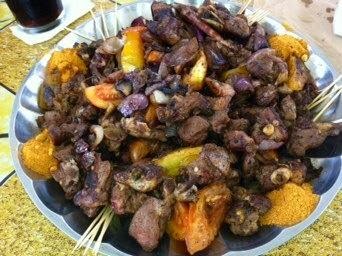
     We spent three chock-full days in Natalie's village, Komtoega.  We were welcomed by groups of  children and adults wanting to say hello and shake our hands.  It was evident that the arrival of Natalie's family was very exciting.  There was a steady stream of people coming to her small cinder-block home, many bearing gifts.  While there we received many home-cooked meals (including To with sauce and grilled goat meat), jewelry, two live chickens, pagne cloths for skirts and head wraps, baskets of onions, peanuts, a beautiful straw hat and more.  The mayor of the village took us to the local bar as did some of the other village officials. There we shared Burkina beer and platters of grilled meat.  Everywhere we went people were scurrying to get us chairs.  It was a bit overwhelming but we were humbled by the generosity of these people who are living under such extreme circumstances.
     First sight of the "marche" was unforgettable.  It is very large and busy and walking through it was amazing. Natalie seems well-liked in this village. It took us a very long time to get from one end of the market to the other.  Kids were following us and everyone was calling to Nat and wanted to be introduced.  Greetings were fairly formal and each one took several minutes. There was an amazing display of goods - tables full of produce, meat, cooked food, hardware supplies, cloth, etc.  We passed one table of goat heads!  It was evident that Natalie knew many people here and walked through the paths with confidence and enthusiasm talking with many people on a personal level.  (She learned that while she was away in Ouagoudougou picking us up, two babies were born and two people died - one the mother of the mayor and the other a teenage boy whose family couldn't afford the dialysis he needed.  When we visited the mayor's home the next day, his mother's body was there in the courtyard under a mound of stones.) We meandered through the village to the tailor's hut to pick up 3 dresses and a shirt that Nat had him make for us.  They're beautiful!
     The first night we spent in Nat's home I was wondering if we could really do this for 2 more nights.  It was very hot and we were so out of our comfort zone - no running water, no toilets, no showers, undrinkable water, etc.   We had to rely on Natalie to tell us everything and she had been translating for us all day long.  I told her that now she knew what it is like to have little kids around her all the time - exhausting.  Her home is fixed up with photos of family and friends and has a nice warm (literally and figuratively) feel to it.  It is also shared with many lizards who scurry around on the walls and a sweet, though neurotic, little dog she has adopted.  The evenings were spent in the dusty courtyard of Nat's friend, Dabre, along with many children.  They come to see Natalie and pass the time.
     Komtoega appears to be a peaceful village.  There are many Muslims, Catholics, Protestants, and animists who live and work together. Natalie has many acquaintances and knew the proper greetings and etiquette when introducing us.  We attended a Catholic mass where we were announced to the congregation - though I only realized it when everyone turned to smile at us and Natalie filled me in on what was going on.
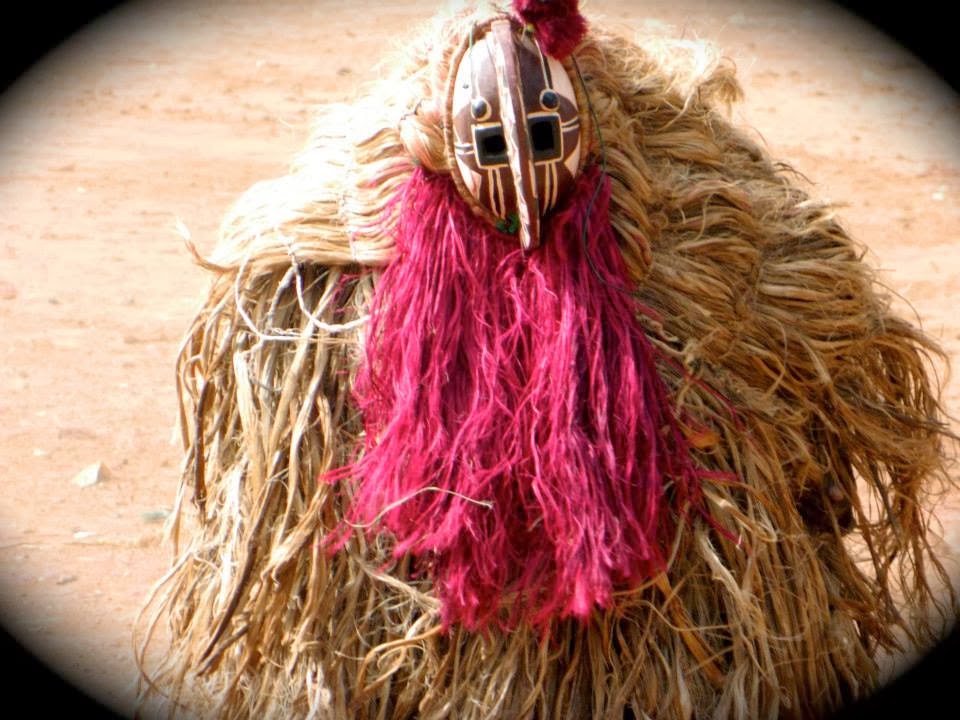
     We  left her village on the third day to go to Dedougou where a mask festival was being held.  It was amazing and well worth the few hours it took to get there.
Many of the Peace Corps workers from around that city were there and we got to meet many of  Nat's coworkers - an amazing group of people who seem to be thriving in the incredibly challenging environment of Burkina Faso.  I have renewed respect for them and what they are accomplishing. We got to hear about their current and upcoming projects.  While in Nat's village we saw evidence of her Flags 4 Future endeavor and her Healthy Schools project. She took us to visit several schools and we were introduced to the teachers and classes.  I don't think I could have lasted as a teacher in BF.  The classrooms were kind of dark and hot and there were so many children in each room!  But, there was evidence of teaching and learning.  Natalie encouraged the kids to ask us questions and say a few words in English.  Our French to them was greeted with laughter.  We could not visit the high school because the students were on strike.  They were demanding cleaner pump water and working computers.
      Well, I could go on but I'm getting carried away.  It was an amazing and unforgettable trip.  It was perfect because Natalie planned for us, translated for us, communicated for us, watched over what we ate, etc.  THANKS, NAT!  You're amazing!  Love, Mom


Saturday, February 15, 2014

FLAGS FOR THE FUTURE (F4F)


It’s hard to believe, but I’ve been back in Burkina for over a month now.  I’ve been keeping busy and preparing for the arrival of my family!  We had our mid-service conference a few weeks ago where we had sessions on food security, a US-AID program called WASH that works with water, sanitation and hygiene, sharing our successes, learning from our failures, and project planning for the next ten months.  We also had check-up doctors appointments and sit-down interviews with our bosses. 
Back at site I have been busy with my Flags 4 the Future project as well as preparing for the Youth Leadership and Development Conference.  Emma came back to site with me after the mid-service conference, and we got right to work making the flags for the project.  Using the grant money I received from the Gender and Development Committee here, I bought the paint and flag materials.  A stencil, which says Notre Avenir (Our Future), was used as well to make the flags.  The stencil was donated by my mom's friend, Helen Brandshaft.  The local tailors stitched the flags while we were busy painting.  By the end of the day we had made about 20, a good start!

With the flag making underway I was ready to have the first training of trainers.  I wanted to start off small to see if the project will work, to have it be more personable, and also to help manage the number of flags I need to make.  We had 3 trainers come to the formation, one from the primary school Yelboulga and 2 from the primary school Langago.  All three of the participants were members of the parents association at these schools.  With the help of a School Director and the School Board President, we led the 2 hour training on the Flags 4 the Future project.  We discussed the importance of education and how it relates to the development of a village, about the importance of educating girls and boys, where Burkina stands comparatively to the rest of the world (183 out of 186 on the poverty scale), the reasons youth do drop out of school (work in the mines, to get married, pregnancy, money problems, etc.) and prevention methods.  We then talked about how to do a door-to-door campaign, what information to cover and how to gather the data. 


The following week the door-to-door campaigns started.  These will continue weekly for the next month, or until all houses in the area have been visited.  The trained members go out in their communities, share the information they learned during the training, gather data on how many school aged children are in the family vs how many are actually enrolled and go to school, and then those families who have all their school-aged children in school receive a flag! 

The project is off to a good start.  Those families who don’t have all their children in school (the majority of the families) listened carefully and asked questions during the campaign.  One mother said she didn’t have enough money to send her child to school last year and I was able to help her plan and save money.  If she saves 300 CFA (less than 1 dollar) a month, she can enroll her daughter in October.  She then informed us that she had never thought about it like that before.  Later, a father told us a story about his twins.  He has two twin girls and only one of them goes to school.  He said the other didn’t want to go and that he tried and tried but she always refused to go.  We asked why this was and he said that on the first day of school, the teacher was calling out the names of students to come up and sign in.  The daughter, whose name is Oussanatou, thought she heard her name being called so she went up in front of the class.  The teacher, who had apparently called Oussana, not Oussanatou, hit the child for getting up without her name being called.  Oussanatou felt embarrassed and scared of the teacher and has refused ever since to go to school.  With the help of the School Board President we came up with a solution.  This October Oussanatou will be enrolled in a different school also close to their house.   Although it doesn’t solve the bigger problem, violence in school, it does help Oussanatou go to school and get the education she deserves. 

Another mother, as we were walking away, yelled across the field, did my neighbor get a flag?  She hadn’t received a flag and I think was surprised to see that her neighbor did.  Part of the goal of this project is to encourage neighbors to talk about the importance of education and together come up with ways that they can send their children to school.   Money, and the need for a child to watch the family’s cattle are two big reasons that children are not in school, but the parent’s knowledge about the importance of educating children is also missing.  I hope this project can help, even if it’s just one family!  Stay tuned for more updates, as I hope to do this project in all the neighborhoods in my village.  

N

Tuesday, January 28, 2014

Back in Burkina


November and December were busy months, which was nice, since it kept my mind off  the anticipation of returning home.  I had the Dance Marathon right before Thanksgiving in a city called Sapouy.  About 12 volunteers and over 70 middle school students came together for a night of dancing, cross-cultural exchange, motivational speeches, and workshops.  We had two adults give motivational talks about youth, their future, how to achieve their dreams, how to avoid trouble, how to be leaders, etc.  We also had workshops on HIV/AIDS, critical thinking and problem solving.   There were two dance competitions and we taught the youth how to do the electric slide, the wobble, the YMCA, and other fun American dance songs.   The event raised over 4,000 dollars and that money is now put in the youth development fund for volunteers to use if they are doing a youth development project at their site.   
In December, after a year of service, I got to return home for the holidays to see friends and family.  It was an amazing two weeks, filled with lots of food, drinks, family time, friends, parties, and travel.   I was relieved to see how easy it was to snap back into life in America and, although I had tons of catching up to do with friends, after a couple hours it felt like I had never been gone!  It really made me appreciate my friends and how lucky I am to have them!  

It also wasn’t as hard to return to Burkina as I had imagined.  The transition was pretty easy and everyone in my village was really excited to have me back.  They loved looking at the pictures from home, and it was fun to give them some of the small gifts that I had brought back for them.  Luckily it is still cold season, so the weather is still nice and I have been staying busy. One question most people kept asking me while I was home was what is a normal day like for me in Burkina Faso.   While this question is pretty hard to answer and can vary so much depending on the month, the weather, what types of projects I’m busy with, if I’m in the middle of a good book, etc, I decided I’d try to write up an example. 

Most mornings I wake up around 8 (unless it is hot season, and then I wake up around 5) and eat breakfast.  This can include village bread with local peanut butter, oatmeal or cereal, which I buy in a bigger city and bring back to my village, or I can go into town and eat an omelet.  After breakfast I either go to the high school to help with English classes, go to the clinic to help with baby weightings, go to the preschool and help teach a lesson or play games with the kids, or I go to a scheduled meeting with the mayor, the school board director, the head nurse, etc. 

Around 12, lunch rolls around and I can either eat in the market or cook at my house.  If I eat at the market I can find salad (if it’s the season), beans, rice, or mutton meat, if I want to splurge.  If I cook at home I can use a gas propane tank to cook with (since there is no electricity!) and I can make pasta.  If I have tuna I can also make a tuna sandwich.  After lunch, depending on what I did in the morning, I usually work on implementing projects or monitoring or evaluating the projects I am working on.  For example, I have an internship program going on twice a week where high school students either help work on reading skills with 4th and 5th graders who are behind, or help out at the clinic learning how to give health talks, take people’s heart rate, etc.  I also created a competition called the Healthy Schools Award Competition between 7 elementary schools, encouraging them to increase health education activities.  The Komtoega School Board and I then go around to the different schools to check in and see how they are doing.  Other than those projects I also am Vice President of the Youth Development Committee and am currently planning a Youth Leadership Conference in March. 

If I’m not busy with work I am usually hanging out in the market with friends, coloring with kids, practicing the local language of Bissa, meeting up with volunteers for a beer in the nearest big village, traveling to Ouaga for a small break, a real shower, and some decent food, or I’m a hermit and don’t leave the house due to an awesome book or a great new TV show (that I can watch on my computer)! 
At night I usually go to my friend Dabre’s house, put on a Disney movie and eat dinner with her and her family.  Dinner almost always consists of the local dish called to (pronounced toe), with different leafy sauces.  Unlike most volunteers, I’ve grown to LOVE to.  I usually read a bit with my solar charging light and then go to bed around 9:30.   

And there you have it, my “typical day.”  It’s taken a while for me to get a somewhat set schedule, and now that I have it I am much more happy and content.  One of the harder parts of my service has been setting a routine, being motivated to go out and look for work to do, and finding local counterparts that are willing to help.  Finally, after about a year in, I can say I have somewhat managed to do this! 
Anyway, you might be wondering what is on tap of the coming months.  Besides the leadership conference I mentioned above, and a Flags for the Future project that I will talk more about in the next blog, my family is coming to Burkina!!!  They will be here at the end of February for about 8 days.  I am beyond excited to show them around and everyone in my village is equally thrilled and anticipating their arrival.  We will probably do about 4 days in the capital, 3 days in my village, and 2 days at a mask festival in Dedegou that happens to be going on at the same time.  I’ll be sure to take lots of pictures and put up a blog post afterwards!
That’s all for now, I’ll write again soon.

N  


Thursday, November 14, 2013

From Demyst to Deliveries


So two weeks ago I got to host 3 new volunteers at my site.    The new group of Community Health and Community Economic Development (CED) volunteers arrived in Burkina in October and are currently doing training in Leo (just like me about a year ago.)  Part of the training includes shadowing a volunteer for 3 days to see what type of work we do, what it is like to live in a village, and to provide an opportunity to ask questions. (The event is called demyst in Peace Corps lingo.)  It was an awesome experience. I got to show off my village, the work I’m doing and how much local language I speak.   It really made me realize that I’ve learned  a lot since a year ago.  I’ve come a long way! 

 The volunteers arrived on Thursday.  I biked out to the intersection to meet them when they got off the transport.  Then we biked back  (for them this was their first bike ride in Burkina) to my house and made eggplant, cheese, tomato, garlic an onion sandwiches.  Food is another important aspect of the weekend because volunteers have been in the country just long enough to be craving American food and sick of the food their host families have been giving them.  After the sandwiches we biked over to my friend Fatimata's house.  Fatimata is one of the ladies that came with me to Fada for the Soy Transformation Workshop.(She learned how to make tofu.)  She currently is President of the Mother’s Association at one of the primary schools and she makes tofu on Thursdays to sell at the Friday market.  We went to her house to meet the other members of the association and to show the new volunteers how to make tofu.  On the way home from her house we passed a wedding and went to go say congrats to the bride and groom.  The new volunteers thought it was so funny that we could just invite ourselves over to their wedding, but that’s how it is here!   It was interesting to realize how normal I felt doing it and how accustomed to village life I am.  People here love guests and feel honored to have Americans at their party.  
The group with the tofu ladies! 
Friday morning I gave them a tour of my clinic and introduced them to the staff.  Every Friday morning is baby weightings so I got to show them how to weigh babies, decide if they are malnourished, and how to advise the mothers if needed.  Next, we went to the local preschool to play with the kids and show the volunteers a song I taught them called “Lave Les Mains” (Wash Your Hands).  Later in the day there was a Polio Campaign going on in my village so we went and followed one of my good friends, and community health worker, Dabre.  We walked around vaccinating children and also giving them vitamin A supplements. 

In the afternoon, I arranged for a 5th grade class to ask questions about the United States to the “panel” of Americans.  Some kids had funny questions like where does the sun rise and set, or do you use a marmite to cook (marmite is a metal pot  that they cook to or rice in).  Other kids asked about what it was like to go to school in the USA. They were all surprised that kids take a bus to school and that they don’t go to school on Saturdays. They were also interested to know  that class sizes are between 18-25.  Here, kids walk or bike to school, they have school Saturday mornings, and there are about 80-100 kids in each class.  The panel asked the kids if they thought  there are  black people in the United States and many kids answered with a confident no!  However, the teacher reminded them that everyone knows Obama and with that they could put two and two together.  We also showed them a map of the world  to point out exactly where the United States is.  Many of the kids were surprised to realize it’s not close to Europe or even that the USA is different than Europe. 

That night we made Alfredo pasta and brochetta.   After dinner we went to my friend Dabre’s house to watch a movie (on my computer).  She was also going to show the new volunteers how to make liquid soap, something the first volunteer in Komtoega taught her how to do.   When we arrived she had made us benga (rice+beans) so we ate a second meal, watched Honey I Shrunk the Kids, and made soap! 
Saturday was market day in my village.  We spent the day walking around saying hi to friends and introducing the volunteers to village leaders.  We also sampled a bunch of market snacks like beignets (bean pastry), benga (rice+beans), bissap (hibiscus juice), and mutton (sheep).  We also went and got henna done at my friend’s boutique.  Leah, one of the volunteers, also got her hair braided with purple weave!  That afternoon the mayor invited us over to sample a traditional Bissa dish.  When we arrived he had set up a big table outside and invited a bunch of people over.  His wife made us bean pancakes that were delicious!  That night the mayor, the head nurse, a village friend, and all the new volunteers went to the local bar where the owner had killed some chickens for us.  The Land Chief (different from the Chief of the Village) was also there along with some teachers who were having a going away party for a high school teacher.   By the end of the night everyone was up dancing together and having a great time!  The weekend went by really quickly and on Sunday they left to go back to Leo for the rest of the training.

On Wednesday of the following week I traveled to Bobo, a big city in the southwest of the country.  Some of my friends were getting together for Halloween.  We made makeshift costumes and went out for some drinks.  Bobo is a really cool city, with a more laid-back vibe than Ouaga.  We were able to hang out by a pool during the day and see live music at night.  
Halloween! 
The next weekend I stayed in village.  On Sunday afternoon Dabre (village midwife) called me and told me to come over to the maternity.  (Since I live on the grounds of the clinic, I was able to walk there quickly.)  I went over and she told me our friend was about to have a baby and asked if I wanted to watch.  Some other volunteers have seen births but I had been avoiding the idea.  I was nervous and had heard some bad stories from other volunteers.  However, since it was my friend who was delivering the baby, and because I knew the mother, I decided to go for it. 

 It was the mother’s second child.  She, like many of the women in my village, was circumcised (female genital mutilation, excision) as a child.  This makes birth more complicated and the hole where the baby needs to come out is smaller than the average women.  The birthing room is basically one room, with recently installed electricity, no running water, no equipment, no towels, hospital clothes, etc.  It is just a room with a black hospital chair that the lady can sit on.  There are no screens on the windows so bugs can fly in and out and outside the window sheep, donkeys and dogs roam around.  The husband does not come to the maternity when his wife is delivering, so usually, a few friends wait outside the room.  Inside, it is usually just the person delivering the baby (whether it’s a village midwife who's never been trained in a school setting, or a nurse) and the mother.  The whole time Dabre was delivering the baby she was carrying another child on her back!   
NEW BABY GIRL 

The birth went fairly smoothly and afterwards they gave the mother a shot so she wouldn’t hemorrhage.  I found myself tearing up when the baby was born.  It was a girl and the mother seemed happy!  They cut the umbilical cord, cleaned the mother and baby, delivered the placenta, and then moved her into a room with some beds.  The next day the mother biked back to her house to show off her new baby!  Seeing a baby being born here was one of the coolest things that I have experienced in this country.  I have never seen a birth in the states before coming here, although I know what a hospital looks like and I’ve seen births on the television.  It was incredibly eye-opening to see how different it is done here.  They have nothing to work with and if something were to happen, the nearest hospital is about an hour away- yet they are so calm and confident.   I hope to see another birth soon, as long as Dabre is delivering it! 

Up next: Dance Marathon, my birthday, Thanksgiving, and then home for the holidays!  Happy Holidays in advance!  Hope to see everyone when I’m home. 
     N

Wednesday, October 30, 2013

Tabaski Festivities


     Work has finally started to pick up with the beginning of the school year a couple of weeks ago.  I have four big projects going on and I am also teaching English three days a week to middle school and high school students.  The class sizes range from 25 students to over 100.  Most of the younger grades have more students but unfortunately, by high school, many students have already dropped out.  None of the students have English textbooks, which makes it difficult to teach.  I am working on ways to make it creative, interactive and fun because the students are used to reading from the board, copying, and then repeating over and over again.   The level of English is extremely low, but hopefully we can work on changing this.  I am also trying to do a lot of teacher training with the current English teachers, although some are more motivated then others.  
     Besides teaching English, I want to briefly explain my other three projects.  The first is a Healthy Schools Award Competition. I created a contest between 7 of the primary schools in my village to see which school can implement the most health activities or increase the amount of health education being taught.  The project is a collaboration between the school board, the clinic, the mayor and myself.   We had the training for this competition last week to prepare the principals, teachers, community health workers, and parents associations for the competition and to train them on the importance of health education.  The competition starts November 1st and each month the schools are required to submit monthly reports with the activities that they have completed.  Points (1, 2 or 3) are recorded, depending on the activity.  There are display boards at the school board’s office and at the clinic to show which schools are in the lead and to allow the community to encourage their schools to win.  Schools are expected to ask their parents association, community health workers, clinic staff and myself to come help lead these health activities.   Each school also received a book called Health For All, which is a collection of example health activities that they can do at the school.   A winner will be awarded in July when the school year ends.  I am working on prizes and funding for the prizes, however I know for sure I am going to do a world map mural at the school that has the most points.  (Geography is really not a strong point here, and so a world map might help people realize that America is not part of Europe.)  If anyone has any other ideas or wants to donate some prizes, let me know!       
     The second project I am working on is the Komtoega Internship Program at the high school.  This project is based on work I did when I was with Spark, a youth development organization in Chicago.  Five students from the high school in my village will be matched to 3 organizations for an 8-week internship program.  This is the pilot group, and I’m hoping to expand the amount of students and organizations involved, if all goes well.  Students will be matched with the clinic, a primary school or a preschool where they will learn about the work these organizations do, the educational background of the staff, and gain valuable skills will helping out.  Before starting, students are trained on professionalism, goal setting, and leadership and communication skills.  The organizations are also trained on how to work with youth, how to set realistic and appropriate responsibilities for the interns, how to be a mentor, and how to motivate youth.  I am really excited about this project and hope it goes well.  Like many of the youth in the states, kids here find it hard to see the connection between staying in school, getting an education, and the real world afterwards.  They need projects like this to motivate them and to challenge them to think about what they want to do after school.  94 students dropped out of the high school last year in my village, and I am hoping projects like this will help them stay motivated and value their education.  The Peace Corps has also asked me to share this project plan with the new group of volunteers during their training program.  Hopefully, after the training program, several other volunteers can implement this project at the high schools in their villages. 
     The third project also involves youth and education (you can see where my interests lie) and was also created because of the need to motivate youth to stay in school.  However, this project also includes the families and parents of the youth.  Many of the parents haven’t finished primary school and don’t see the value of their child’s education.  Financial problems, arranged marriages and early pregnancies are also factors.  The project is called Flags for the Future.  It is a collaboration between the 14 primary schools present in the school district of Komtoega, each Parents Association, Peace Corps and the Mayor.  We are having two door-to-door campaigns to talk about the importance of education, how education and the development of a village are related, and why families should send their children to school.  During the first campaign we are also recording the statistics of each family to see how many school-aged children are enrolled in school and how many should be attending, but currently are not.  Then, during the second campaign, we will be distributing flags to each family that is managing to send all of their school-aged children to school.  The goal is that families will see their neighbors with flags and conversations will begin about education and how to financially save money for education.   Families will become motivated to send their children to school, the youth drop-out rate will decrease and the flags will be known throughout Komtoega as a symbol, showing that parents do value their child’s education.  Once all the materials are purchased, local tailors will be helping to make the flags and paint the logos on using a stencil.     
     Lastly, I am currently Vice President of the Youth Development Committee in Peace Corps Burkina Faso, and we are planning a dance marathon.  The event will be held on November 23rd to raise money for the Youth Development Committee Fund.  This fund will finance volunteer projects that relate to youth development.  (For example, theater groups, fieldtrips, camps, etc.)   Volunteers and around 100 Burkinabe will be dancing to raise money.  There will also be motivational speakers, health talks, and dance competitions during the event.  Each volunteer who is participating in the event is required to raise $150.  We are also hoping that schools in the states will host their own dance marathons to help us with fundraising.  If you have family or friends involved in the school system who might be interested in teaching their students about another culture and helping the youth of Burkina, please let me know! If not, please help us raise funds by clicking this link: www.peacecorps.gov/donate. You must click on Donate to Country Funds on the left side first.  Then click on Burkina Faso.You must type “YDC projects” into the comments section on the donation site. Also, please let me know if you do contribute, as I can not see the names of the people, but definitely want to thank you.    
     Okay, sorry for the long spiel about the work I am doing at site.  I just wanted to catch everyone up to date with what I am doing over here.   Besides work, I am still hosting movie nights at my friend’s house.  In the last blog I wrote about how much they liked Cinderella, but I definitely spoke too soon.  Jungle Book is their absolute favorite.  We have watched it at least 5 times and whenever I come over they attempt to sing “It’s just those, bare necessities” and beg me to show the movie.  They roar with laughter when the little boy tries to walk like an elephant and they think it is hilarious when he dances with the bear while singing the Bare Necessities song.  On several occasions grown men and women are sitting with their little kids watching Jungle Book and the whole courtyard is laughing.  I like showing the movies because it provides an occasion for families to just hang out together enjoying themselves.  Harry Potter has also been a favorite, and the high school kids love to come to the courtyard and ask to watch the 2nd, 3rd,  and 4th Harry Potters.    
     Last week we celebrated the Muslim holiday of Tabaski.  In the states it is called Eid al-Adha.  
I got up early to celebrate and headed directly to the mosque.  I was shocked to see how many people were already up and celebrating.  There was a huge mob of people surrounding the mosque but luckily I found my friend, the pharmacist, and went over to say hello.  She explained the local language greetings that I can use to say “Happy Tabaski” and we also took a picture. Next, she told me to go visit the village chief because a lot of people went to his house to greet him.  He and his mother had come from the capital to celebrate. He doesn’t live in my village, and I had never met him before.   My friend,the pharmacist, couldn’t come with me because she  had to go cook, so I got on my bike and started peddling over to his house.  As I arrived, I started to get nervous because I was by myself and there were so many people.  Luckily, I saw another friend and went right next to her.  However, since I am the only white person in my village, I stick out like a sore thumb.  Everyone wanted to find me a seat in the shade and wanted me to get close so I could take pictures. They wanted to give me candy and Fanta and they  wanted me to meet the chief..  All of this commotion was going on while people were praying for a happy year, good health, lots of kids, etc.  I felt like I was making such a scene, when all I wanted to do was be an onlooker from the back.  Next thing I know a man has grabbed my hand and we are making our way through the crowd.  He is informing me that he is taking me to see the chief and that I need to say hello.  Everyone is now looking at me and waiting to see my next move.  Finally we arrive front and center.  The chief is sitting in a huge throne-like chair and they have even placed a stuffed animal lion next to him for effect.  We are now kneeling on the ground ( me and the man holding my hand) and it is time to say our greetings to the chief.   The man goes first and I am trying my best to listen to what he says in Bissa, the local language, so that I can try to say the same thing.   Of course, I catch like one word and when it is my turn, I say the two greetings that the pharmacist taught me.  “Can o tabokee” which means Happy Tabaski, and “Woosoh dolah ayentah can” which means may God give you a good year.  After I said these two things, the chief still hadn’t said anything back. Everyone is waiting to hear the next thing I’m going to say.  Luckily, all of the sudden, the chief begins to talk and he said… in PERFECT ENGLISH (such a rare thing to find here)…“Thank you for celebrating with us in my village.”  We continued to have a conversation in English and then finally, I was able to step off the podium and walk back through the crowds and out of the spotlight.  I couldn’t believe that all of my nerves and worries could have been avoided if I had known ahead of time that he spoke English!  I looked down at my hands after and they were still completely shaking.  Next year, I’ll be prepared. 
The Village Chief and his Lion 
Me and my friend, the pharmacist, celebrating Tabaski


Friday, August 23, 2013

Summertime, and the Livin's Easy


Wow, I just looked at my last post and realized I haven't written since May!  I can blame some of that on computer problems, but luckily I'm up and running. So, what have I been up to this summer? Summer here means rainy season so everyone heads to the fields to cultivate.  My village plants mostly peanuts, millet, and rice.  The rain started off slowly, raining about every couple of days, however, it has picked up in the past couple of weeks, and boy is my community happy about this!  Rain here means life.  If it doesn’t rain, their crops don’t grow and they wind up with not enough money or food.  The rainy season got off to a really bad start, and they were predicting that it could be as bad as the drought in 2006, so let’s hope the rain keeps up! 

In early June I spent time in my village doing a variety of things.  I worked on a polio vaccination campaign, training community members on how to give health talks. I also prepared for the rain and malaria season, taught English to high school students, wrote a grant for a project teaching computer classes, and just hung with my dogs. 

The polio vaccination campaign involved walking around, house to house, and giving out a polio vaccination to children.  The vaccination was just a drop of medicine into the kid’s mouth and it was nice to be able to help.  It was also nice to walk around the village visiting different families and getting to know more of the community.

Later in the month I went to southwest Burkina, to a small city called Oradara.  I brought an older man who works closely with one of the primary schools in my village.  We attended a conference that taught him and other host country nationals how to give health talks, which here we call sensibilizations. The conference covered the different types of health problems that occur in village, (such as malaria, HIV/AIDS, malnutrition, diarrhea and unhygienic practices) the different ways you can teach the community about these issues (for example using theater, sports, small talks, door-to-door campaigns) and gave the locals a chance to practice talking about these issues.  The conference got off to a rocky start.  The counterpart that I brought was shy and older than the other volunteer’s counterparts.  I also found out, after arriving in Orardara, that he was illiterate.  This was surprising since he spoke perfect French, had lived abroad in Europe for a small time during his youth, and holds several key positions in my community.  Anyway, we made it work, and he was able to learn a lot from the conference.  By the end, he had become everyone’s favorite “grandpa” and he was able to give health presentations. 

Me, my counterpart, Emma's counterpart, Emma 
Emma's party with the roasted pig! 
My mom's 60th birthday dinner! 
Cliffs of Moher, Ireland 

July was also an extremely busy month.  For July 4th, I traveled to a volunteer’s site up north, called Yako, where about 30 volunteers were gathering to celebrate.  We had water games, cold beer, and great food.  We decorated in face paint and wore red, white and blue.  I even was extra festive and got my nails done in village before I left.  (See picture below!)   It was fun to celebrate with other Americans even though we weren't celebrating in the states.  
                                
A couple of weeks later, another celebration was in order.  One of my volunteer friends, Emma, was turning 23!  Emma is one of my good friends here and she is also my closest Peace Corps neighbor.  For her birthday, some volunteers came to my house to have a surprise party for her.  The party was a success and we even roasted our own pig!   

At the end of the month I went out East to Fada, where I helped work a 10-day camp.  16 volunteers worked the camp that was attended by 77 Burkinabe youth.    The camp, called Camp G2LOW, focused on three themes:  Promoting Healthy Lifestyles, Empowering Students and Promoting Gender Equality.   G2LOW, which stands for Girls and Guys Leading Our World, involved several of the same activities you would see at a camp in the states, including a bonfire, sports, theater night, movie night, etc, but also included educational sessions, such as proper hygiene, safe sex practices, HIV/AIDS, gender equality, and malaria.  For more information about Camp G2LOW, please visit this link: http://pcburkina.org/camp-glow.  

The camp was probably the best thing that I have done in country thus far.  It was a lot of work but it was totally worth it and the kids had a blast!  Most youth in Burkina aren't given the opportunity to attend summer camps so this was a completely new and exciting experience for them.  It was also a chance to reward the students for their success and hard work in school.  The 77 students were hand selected and were top in their class across the region.  It was great to see them arrive so shy and quiet and leave completely comfortable, outgoing, and having met lifelong friends.  

Each volunteer had to lead 3 sessions (in French) with a local counterpart who was also helping at the camp.  I taught a session on malaria, puberty, and saying "no".  I was most worried about teaching the puberty session, since the topic can be awkward and I didn't know a lot of the French equivalent vocabulary words.  However, it went much better than I had expected and wound up being my favorite session!  The girls had so many questions and were so interested in the topic.  They had never been taught about their bodies and were told to not ask about those types of things.  So, for them to witness an American and an older lady (my counterpart) talking about things like menstruation, reproductive health, or biological changes, they were dead silent and all ears!  

Below is a picture from the camp.  Also google Camp G2LOW Burkina Faso on YouTube and you can maybe see an old video of last years camp, or if it is up, this years camp.  

After camp I went back to village for one night and then left to meet my family in Ireland!  I am currently writing this blog in the Paris airport, waiting for my flight back to Ouagadougou.  It was hard to say goodbye to the family, after spending 10 amazing days traveling around Ireland, however, I will be home for Christmas, which isn't too far away! (can’t wait to see everyone!!!)  

Ireland was an awesome vacation!  It was so nice to see my family, travel around the gorgeous countryside, and eat good food!  The weather was really nice too, sunny and between 65-70, which is really nice for Irish standards.  For me, it was a nice break from the scorching temperatures that I see in Burkina. 

We started the trip out in Dublin, which is an amazing city with awesome bars, restaurants, sights, and friendly people.  We visited Trinity College, did a walking tour and went on a pub-crawl.  We also did some shopping, fine dining and visited the Guinness Factory.  It also happened to be my mom's 60th birthday!  We went out to a really fancy steak restaurant to celebrate!  I was so happy to be with my family on her birthday!


From there we took the train to Cork, picked up a rental car, and began our drive to Kinsale.  The driving turned out to be a little more difficult than planned, although somehow, we managed to not get in any accidents.  Part of that was because of my excellent co-piloting skills and the other half was due to the sign that my sister held up in the backseat, that read, “Sorry, we’re American!”  All things considered, my dad did a good job and we saw several tourists on the road that had scrapes on their car.    

Kinsale is a beautiful town on the water, where many Irish go to vacation during the summer.  It’s a quaint little town with small pedestrian streets, pubs, castles, and restaurants.  Our hotel looked out at a beautiful marina and was located right next to a park.  We went on a castle tour, a wine tour, bought some artwork at the local shops, and listened to some live Irish music at night.    We were only there for one night, and the next day we set off again, to the Dingle Peninsula. 


Dingle is picturesque town with incredibly hospitable people.  We stayed at a bed and breakfast called Greenmount House, where Julia Roberts once stayed in the 90’s. One of the first people we met was quick to tell us that the town has about 2,500 people and 52 bars!  We stayed in Dingle for two nights, although it’s relaxed atmosphere had me wanting to stay for longer!  We had a great tour guide who took us around the peninsula.   We drove around the cliffs on the Slea Head Road (we were so happy we had a driver) and then took a boat out to the Blasket Islands.  One night we went to a great seafood restaurant (although I had sweet potato gnocchi) and the other night we ate at restaurant called Ashes, where I had a big steak!  We also met another family in the restaurant from Arlington, VA.  Such a small world!  After dinner we went and heard more live music.  At one of the pubs we met a funny older guy named Stephen.  He was from Pittsburgh but also lives in Dingle.  He used to play for the Giants and he was definitely a character.  He had already drunk a few whiskey on the rocks when we met him and he kept insisting that he wanted to sing with the band that was about to start.  We assumed he was just drunk and was goofing around, however, about 4 songs in, the band let him come up to sing.  It was basically a scene similar to that of Susan Boyle.  He had an amazing voice and was belting out these beautiful Irish songs.  He also is Saint Patrick in some the Dublin parades each year and was a town favorite.   Below is a picture of him!

From Dingle we headed northwest to Galway.  Galway was a totally hip, young town, with lots of bars and restaurants.  There were several closed streets where only pedestrians could walk.  We hired another great tour guide who drove us out to the Cliffs of Moher (definitely one of the most beautiful sites I’ve ever seen) and to visit the Dunguaire Castle.  We also toured some small Irish villages where we stopped to get lunch, which consisted of Guinness beef stew!  After Galway, we dropped the car off and took the train back to Dublin for our last night in country.  Overall it was an excellent trip and Ireland is definitely somewhere I want to re-visit one day.  

Being back in village has taken some time to get used to.  I forgot how slow-paced village life is and I've been finding myself bored and with nothing to do.  A lot of this is because school is out, it rains a lot, and everyone is farming.  Some of my friends are still around however, and I was able to bring them back some chocolate souvenirs.  They also loved to see all my photos, especially the pictures I took of food.  They were fascinated with the different dishes I ate and the fact that it wasn't rice!  

I have also been having movie nights in village with the kids.  I've been going to my friend Dabre's house after dinner and showing a kids movie on my laptop.  I've showed Tarzan, Brave, Tangled, and everyones personal favorite, Cinderella.  Everytime I show up the kids yell that they want " Cindrone" "Cindrone".  Not sure where they got that name from, but we have watched Cinderalla two times already.  Movie night starts off with about 5 or 6 kids watching but by the end of the movie, grown men, mothers, and about 20 kids are all crowded around my computer laughing at the talking mice, or oohing and awing over Cinderella's pretty dress.  I love sharing these childhood movies with my village.  I think the next on the list will be Lion King!    N